
QQQ weekly: 29 Jun - 3 Jul 2026
Rangebound

Price action
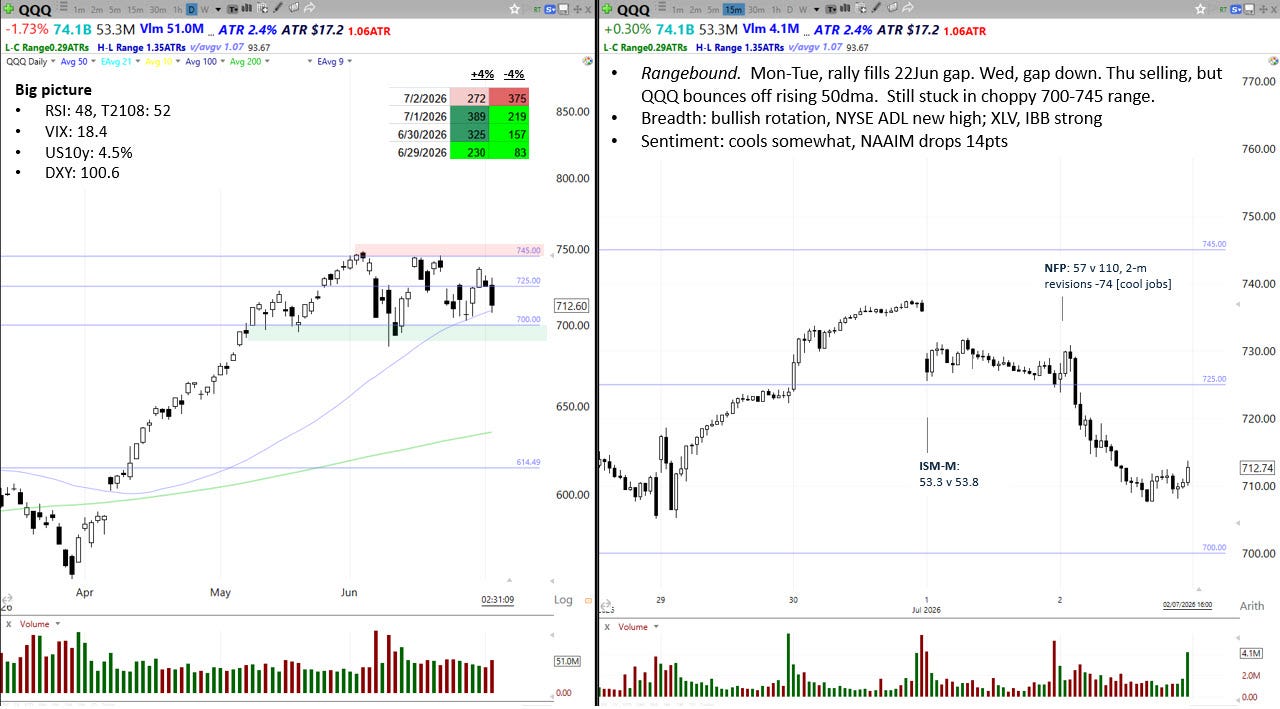
QQQ continues to chop around in a wide range between 700 and 745. After a bounce on Monday and Tuesday, sellers appeared again on Wednesday, and by the close on Thursday, QQQ had round-tripped the four-day week.
Note the rising 50dma held on Friday, but also note it has been tested twice in the last five sessions.
The Fed
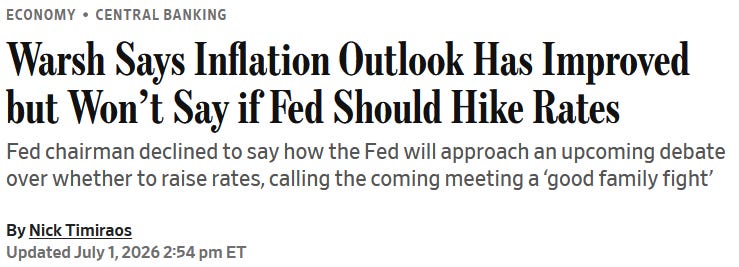
On Wednesday, Kevin Warsh gave his second public appearance as Fed Chair, this time at the ECB’s symposium at Sintra. Just as at the Fed day presser, Warsh sought to impress his inflation-fighting credentials, “we're going to deliver price stability.” He also pushed back against forward guidance and suggested the dot plot would only continue for a short while longer.
But, there was one dovish glimmer - Warsh said he believes the threat of persistent inflation has moderated, specifically citing declining inflation expectations in both surveys and bond pricing over the past month (which we flagged last week).
As for data, June NFPs were released on Thursday, coming in at 57k v 110k, along with -74k of revisions to the prior two months. If this is a sign of some cooling in the economy, and energy prices continue to fall, then market-implied probability of Fed hikes by the end of year may begin to fall, which would be constructive for QQQ.
Markets & Narratives
AI
Since the AI theme took off with the release of ChatGPT in November 2022, the story has unfolded in a sequence of acts. Act one was all about AI GPUs for training. In act two, the story broadened out to datacenter equipment and construction. Then in act three, agentic AI arrived along with CPU demand and memory bottlenecks.
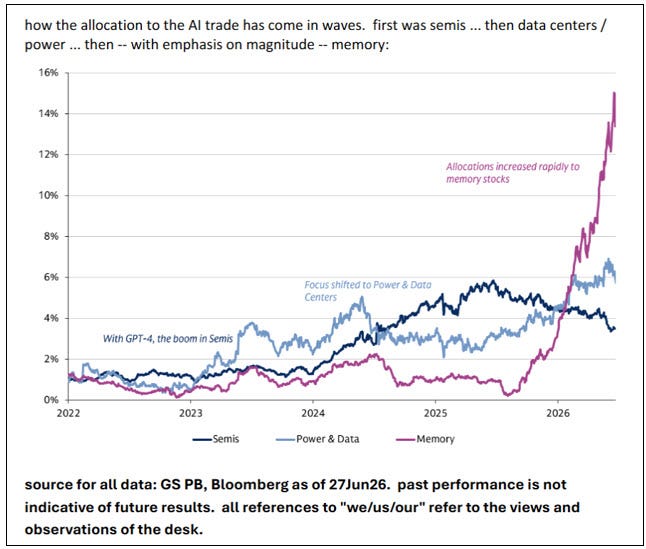
While the narrative arc has been very bullish, it has been punctuated by episodes of uncertainty and doubt, for example the Deepseek efficiency scare in January 2025, which raised questions whether AI needed so much compute. We may be entering another episodic wobble with the emergence of three stories this week:
First, the Information reported OpenAI has developed software optimisations that more than halve inference costs.
Second, Bloomberg reported META is building a cloud business to sell excess AI compute. META rose over 10% while neoclouds CRWV and NBIS fell 10.8% and 12.4% respectively on concerns about overcapacity.
Third, it was reported that AAPL is in talks to buy memory from China’s CXMT and YMTC, which raises concerns about the Samsung/SK Hynix/Micron oligopoly and their margins.
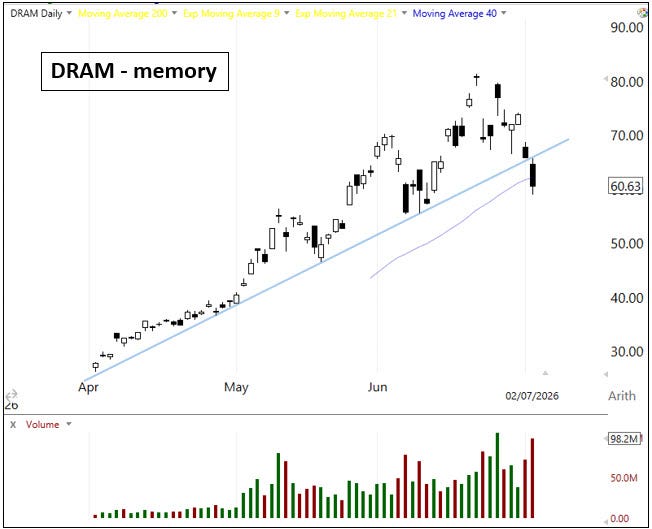
These concerns have translated into volatile price action in the AI theme, with moves amplified by a wall of leveraged money that has entered the space. Last week, we noted the huge increases in the AUM of leveraged ETFs holding Korean memory names, and the fact that broker margin in Taiwan had reached dotcom-era highs. This week, the memory ETF DRAM fell -16% and is now down -25% from its high. KORU, the 3x leveraged KOSPI ETF, is down no less than -57% from its high. It may be that these moves are a function of leveraged traders being liquidated rather than due to fundamental deterioration; but, whatever the reason, DRAM’s chart in particular shows a trend break on high volume, and perhaps a new phase of less friendly price action.
Breadth
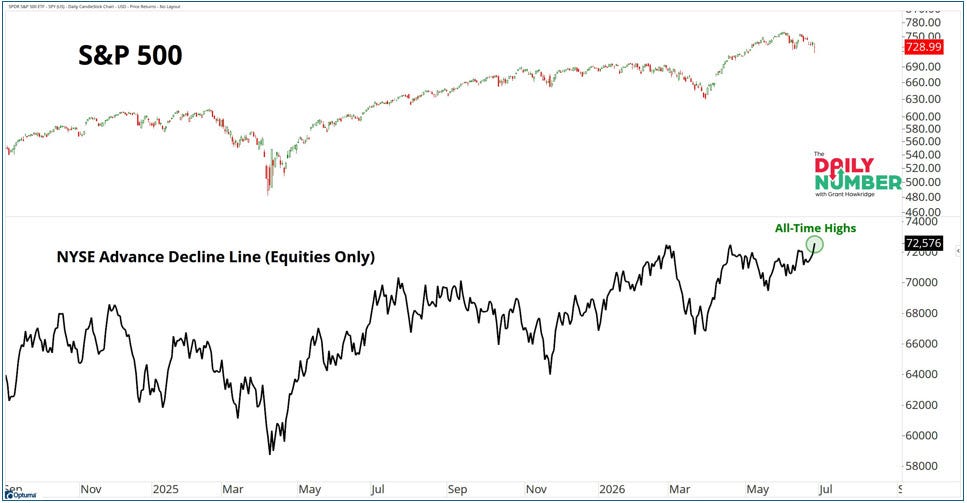
While QQQ struggled alongside DRAM, SOXL, and other AI rippers, most of the market acted fine this week. DIA made a new high, and the NYSE Advance-Decline Line also made a new high, which is constructive (hat tip Grant Hawkridge).
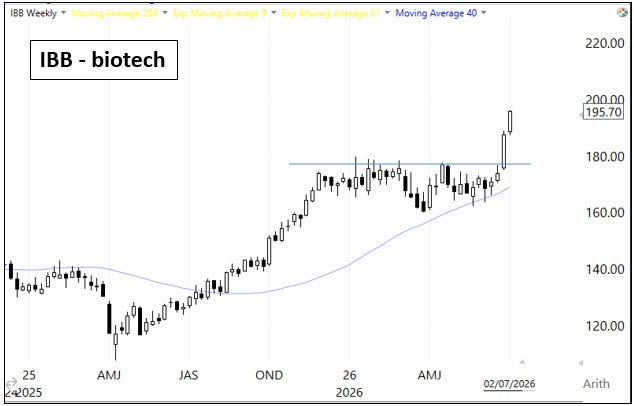
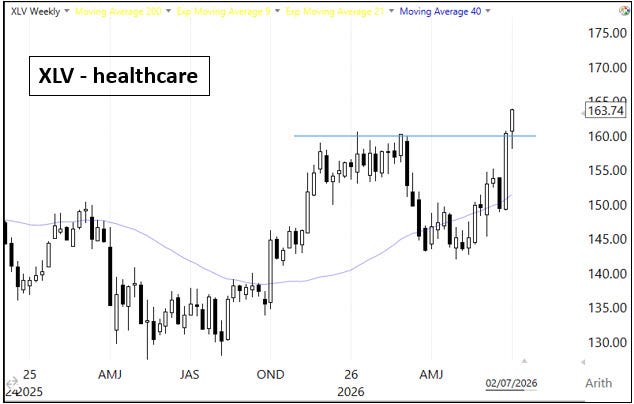
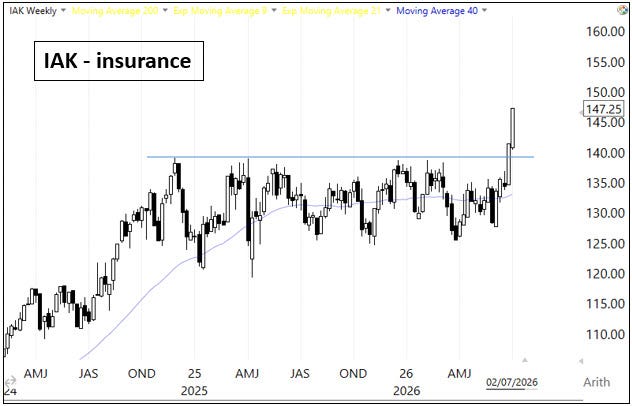
There have been pockets of great price action in sectors away from tech. The breakouts we noted in recent posts in healthcare, biotech, and insurance continue to go well. This isn’t the sort of thing you see in a market that’s falling apart.
Sentiment & Positioning
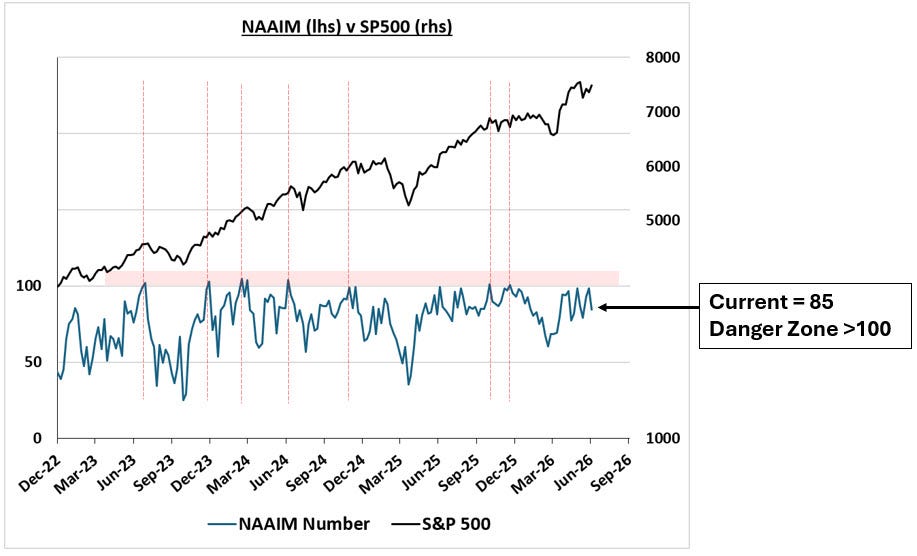
In my last post I expressed caution because several sentiment indicators had reached “too bullish” levels. In particular, the NAAIM number had reached 99, and the Bank of America Bull & Bear indicator was at 9.1, plus we saw clear anecdotal evidence of euphoria among retail traders in Asia.
This week, the NAAIM numbers eased back to 85 from 99, which is constructive. However, I can’t help thinking that having reached as high as 99, we should expect a further period of flat or corrective price action. That would enable sentiment to re-set properly and open the door to further upside later in the year.
Seasonality
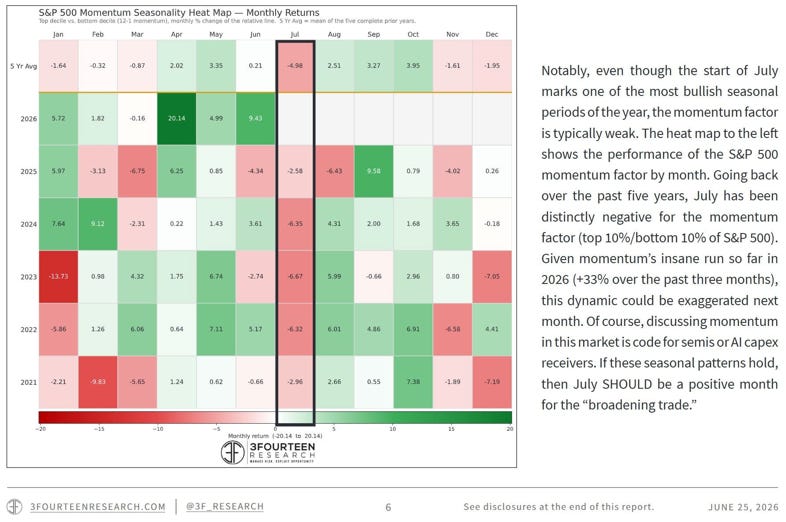
July is a seasonally strong month for US stocks, although perhaps not quite so strong in midterm years. One nuance about seasonality is that the momentum factor has been weak the last five Julys in a row. The AI theme and the momentum factor have become synonymous in recent years. N=5 is not a big sample, so pinch of salt required, but this is a pattern to be aware of. Hat tip Warren Pies.
Summary
Price action: QQQ is rangebound short-term. The long-term primary trend is bullish.
The Fed: Did Kevin Warsh say something dovish at Sintra? NFPs came in cool.
Markets & Narratives: The AI theme may be entering a phase of narrative uncertainty and choppy price action.
Breadth: the NYSE ADL made a new high, while sectors ex-tech saw nice-looking breakouts (IBB, IAK, XLV).
Sentiment & Positioning: cooling after last week’s strongly bullish readings
Seasonality: July is seasonally strong, but less so in midterm years. Note July weakness in the momentum factor over the last five years.
Key events next week: ISM-NM (Mon), FOMC Minutes (Wed), Williams (Thu)
View
Short-term: choppy range likely to continue a while longer
After a steep rally in April and May, we’re now in a digestion phase. Once sentiment and positioning reach very bullish levels (as they did a week ago), then it’s harder for the market to push higher. Until we get a proper sentiment re-set then I think we’re stuck in a choppy to down phase. With the difficult Q3 months of August and September not far away, I wonder if we have a protracted and frustrating range until we get close to the midterm elections?
For my trading, I’m focusing on short-term opportunities and intraday moves, as opposed to longer-term swing trades that worked well in April and May. However, I’m keeping an open mind, and I’m watching for rotation into laggard sectors while the AI theme takes a breather.
Long-term: cautious bullish (no change to my long-term view this week)
From a long-term technical perspective, QQQ is trending in a bullish primary channel in play since late 2022. It sits above its long-term moving averages, which are sloping upward. The bull market is intact.
From a fundamental perspective, there are tailwinds supporting the long-term bull market. Fiscal support continues, with the US running a large deficit that stimulates the economy, which is strong; corporate earnings have been stellar; the AI theme suggests trillions of annual capex spending ahead.
While I’m bullish from a long-term perspective, I’m somewhat cautious on a 6-month view on the basis of unhelpful midterm seasonality until Q4.
If you find my posts useful, please do share with friends and colleagues.
See you next week,
Alex