
QQQ weekly: 20 - 24 July 2026
Sliding

Off on holidays next week, next post will be Monday 10 August.
Price action
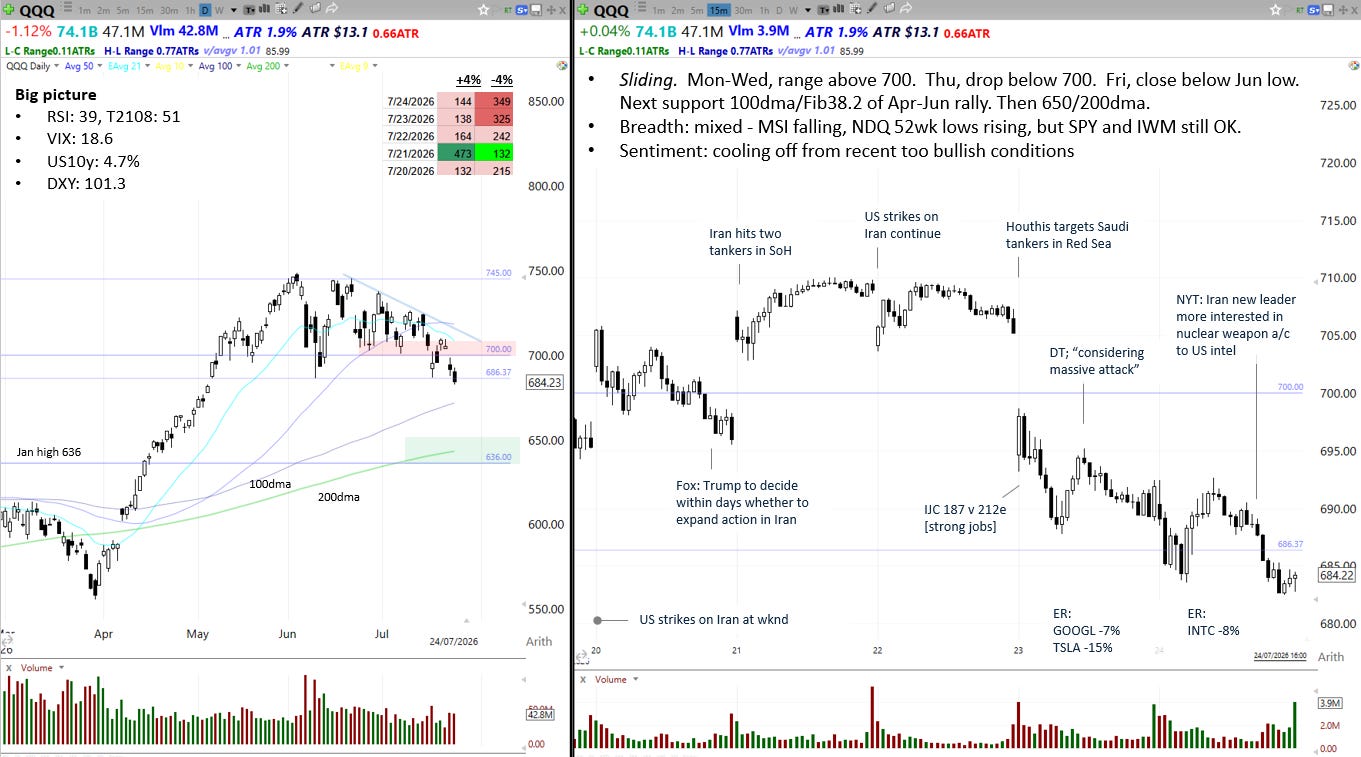
From Monday to Wednesday, QQQ held above support at 700 despite continuing hostilities between America and Iran. However, QQQ gapped down on Thursday and slid lower to Friday’s close after the Houthis targeted Saudi tankers in the Red Sea (a new zone of engagement in the Iranian conflict), and GOOGL (-7%), TSLA, (-15%) and INTC (-8%) all sold off after their earnings reports.
QQQ closed the week below the June low at 686. 700 looks like it could act as resistance on a re-test, while the declining trend line resistance from the June high also looks problematic. QQQ is not yet oversold, either in terms of RSI or extension below its moving averages, so there is scope for this move to travel further.
As for support, the 100dma around 672 may offer some help. Below that, there’s a confluence of support around 650, which is a significant round number that coincides with the 200dma and the 50% retracement of the April-June rally. If we get there, that would constitute a -13.5% pullback from the high.
The Fed
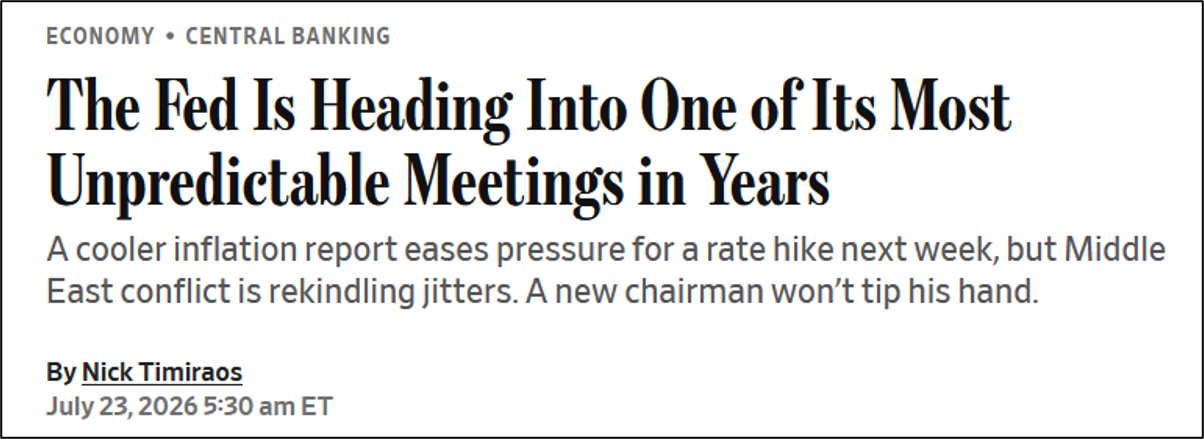
The Fed was in blackout ahead of next week’s meeting, so there were no FOMC speakers to steer the market. Oil rose as the Iranian conflict intensified, with Brent hitting $100, and two data points (Initial Jobless Claims, which fell to a 2026 low, and PMIs, which included an elevated prices paid component) somewhat undermined the cooling picture from CPI and NFPs earlier this month. As a result, the market-implied probability of a hike at next week’s meeting lifted to nearly 40% according to the CME Fed Watch tool.
That seems too high to me. IJC and PMI were strong, but they are second tier releases compared with CPI and NFP, which were surely cool enough to allow the FOMC to stay on hold. Yes, we have heard some hawkish commentary from FOMC members recently (for example Logan and Hammack last week), but the fact remains the last dot plot showed half the FOMC seeing rates unchanged till the end of the year, a group that if anything may have grown after this month’s inflation and jobs data. Furthermore, if they do hike this meeting, it would be delivered to a market that is still, on balance, expecting a hold. The Fed does not traditionally like to take the market by surprise as it risks destabilising markets and tightening financial conditions. So, my base case is they hold next week and take another look in September.
However, one needs to keep an open mind with so many uncertain factors at play. Is AI inflationary or disinflationary? Has tariff-related price pressure dissipated? Will the Iran conflict intensify or fade? Judging the Fed’s reaction function to these cross-currents would be hard enough on its own, but now we also have to contend with the unfamiliar and inscrutable Kevin Warsh. My suspicion is that his hawkishness has been performative, but we will find out on Wednesday…
Markets & Narratives
1/ Iran
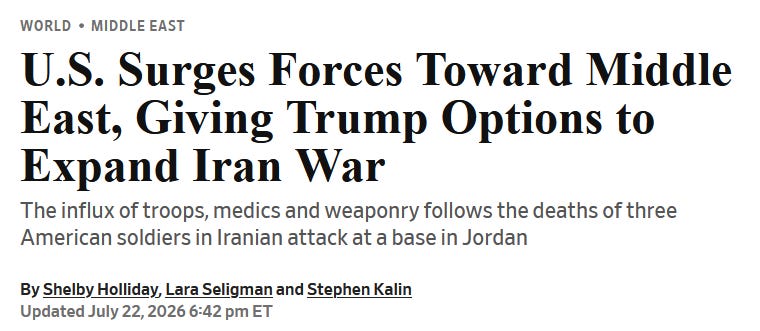
As we write this, there are signs of modest de-escalation over the weekend, with Bloomberg reporting that America and Iran have paused their exchanges and talks are recommencing (at least between Iran and Oman). Weekend markets show oil is off a fair bit: Hyperliquid shows WTI -5.5% since Friday’s close. However, the recent surge in US troops to Europe and the Middle East suggests things may be moving in the other direction.
2/ AI
GOOGL reported earnings on Wednesday. Revenue rose 24% year on year, and cloud revenue jumped 84%. The problem was their guidance for 2026 capex, which they raised from $180-190b to $190-210b. The market didn’t like it, and GOOGL fell -7%. Look out for similar dynamics when the other three hyperscalers report on Wednesday and Thursday.
3/ Bond yields
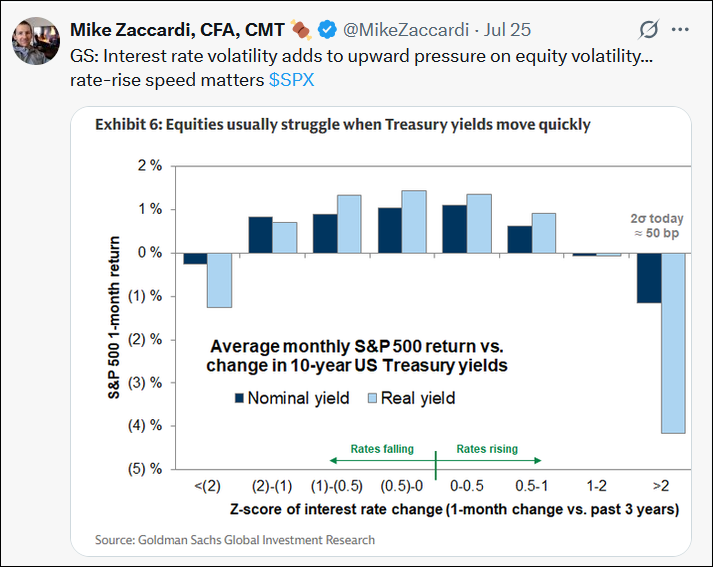
The yield on the UST 10-year is looking like it might want to break 5%.
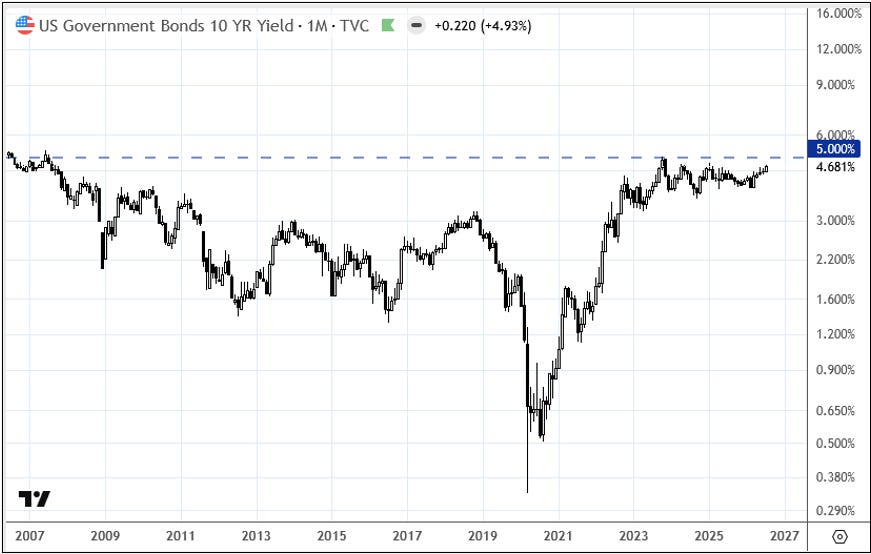
A fast break of 5% would be a headwind for QQQ - the speed of bond yield changes is more destabilising for equities than the level.
Breadth
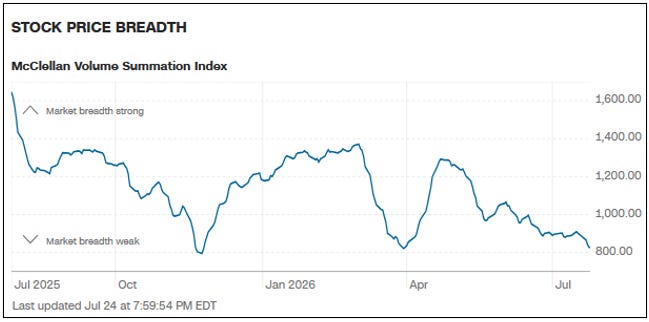
A mixed bag. On the one hand, SPY is holding up relative to QQQ, and there are still areas of strength in financials, insurance, healthcare, and biotech. However, the McClellan Summation Index is falling and new Nasdaq 52-week lows are rising.
Sentiment & Positioning
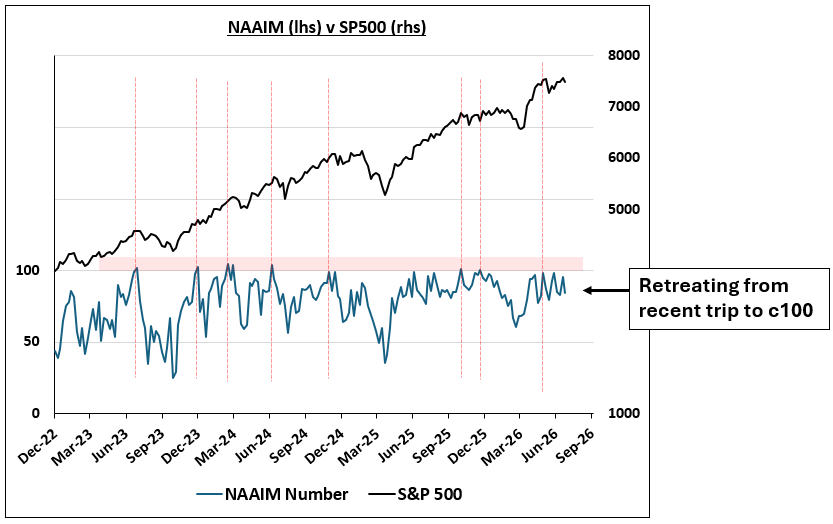
Broadly, sentiment indicators continue to cool off having recently hit “too bullish” levels in June and July. The NAAIM fell back to 84 this week after its recent trips within a hair’s breadth of 100.
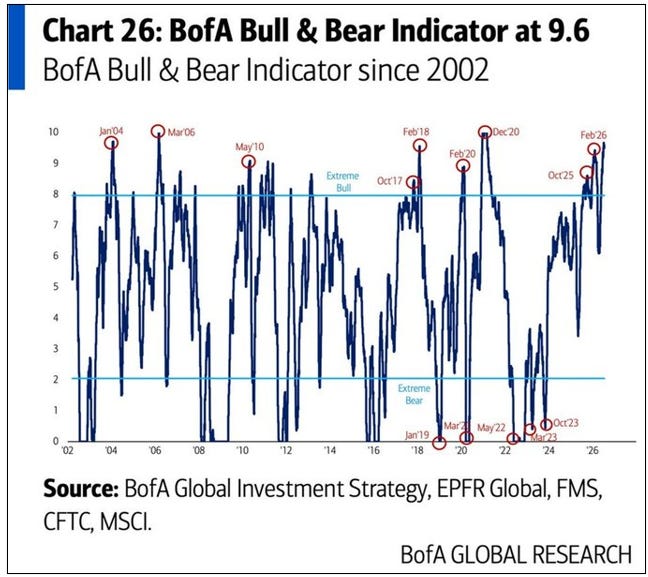
However, some indicators still look problematic, especially Bank of America’s Bull & Bear Indicator at 9.6.
Seasonality
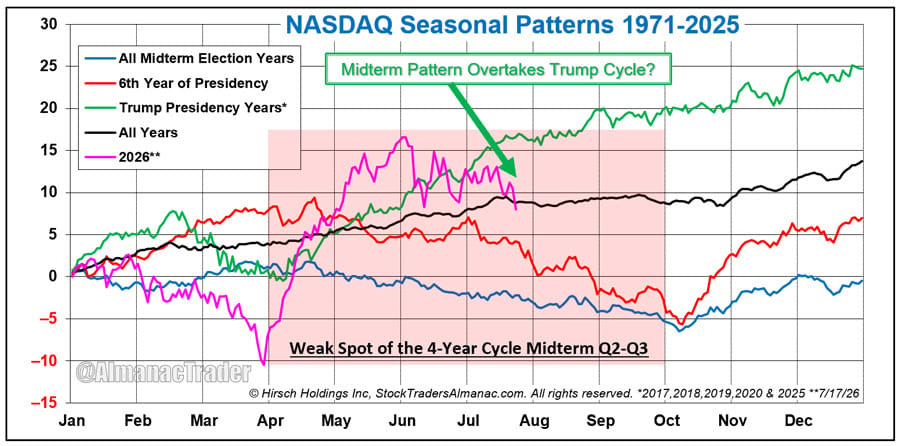
Here’s another take on midterm seasonal weakness from the king of seasonality, Jeff Hirsch.
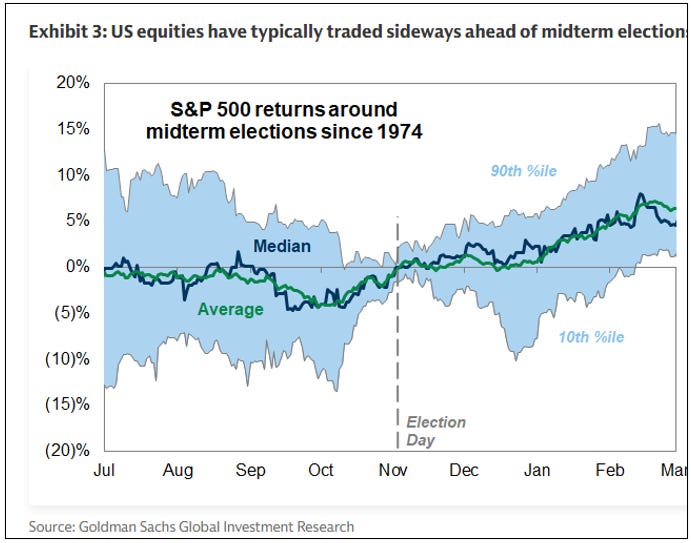
Here’s a take from Goldman.
Summary
Price action: QQQ slid further, and closed below support at 700 and the June low at 686. QQQ is not oversold. There is a confluence of support at 650. The long-term primary trend is bullish.
The Fed: the market-implied probability of a hike at the Fed’s 29 July meeting rose to 40%.
Markets & Narratives: 1/ Iran - re-escalating/de-escalating? 2/ AI - GOOGL reacted badly to increased capex guidance 3/ Bond yields - a fast break above 5% for the 10-year yield would be problematic.
Breadth: mixed
Sentiment & Positioning: NAAIM fell back to 84. However, BofA’s indicator remains red hot at 9.6. A full sentiment re-set is still needed.
Seasonality: a period of seasonal weakness is approaching as midterm elections appear on the horizon.
Key events next week: Iran headlines, Wed - Fed day, earnings from MSFT, META, ARM, QCOM; Thu - earnings from AAPL, AMZN, OWL.
View
Short-term: further chop likely
As we noted last week, thematic headwinds have picked up. This week, rising bond yields joined a long list of them including the Middle East conflict, AI confusion, and the approach of the midterms. We also have an uncertain Fed meeting to deal with next week. While a hawkish hold seems most likely to me, with maybe a couple of dissenters voting for a hike, for once there seems real scope for the market to be caught offside by the Fed, which would not be familiar ground at all. Add in that sentiment still needs a proper re-set, plus poor seasonality, and my base case is for continuing chop or a slide lower.
One short-term scenario to consider is a sudden flush lower sometime next week, which could reach the 100dma or (if things get very dramatic) the 200dma. That could set up a tradable short-term bounce.
I’m still focusing on shorter-term opportunities and intraday moves, as opposed to longer-term swing trades. Intraday shorts continue to work quite well in this market.
Long-term: cautious bullish (no change to my long-term view this week)
From a long-term technical perspective, QQQ is trending in a bullish primary channel in play since late 2022. It sits above its long-term moving averages, which are sloping upward. The bull market is intact.
From a fundamental perspective, there are tailwinds supporting the long-term bull market. Fiscal support continues, with the US running a large deficit that stimulates the economy, which is strong; corporate earnings have been strong; the AI theme suggests trillions of annual capex spending ahead.
While I’m bullish from a long-term perspective, I’m cautious on a 3-4 month view on the basis of unhelpful midterm seasonality until Q4.
If you find my posts useful, please do share with friends and colleagues.
See you next week,
Alex
https://www.linkedin.com/in/alex-campbell-cfa-cmt-876b331/