
QQQ weekly: 20 - 24 Apr 2026
Pause c.650, strong close

Price action
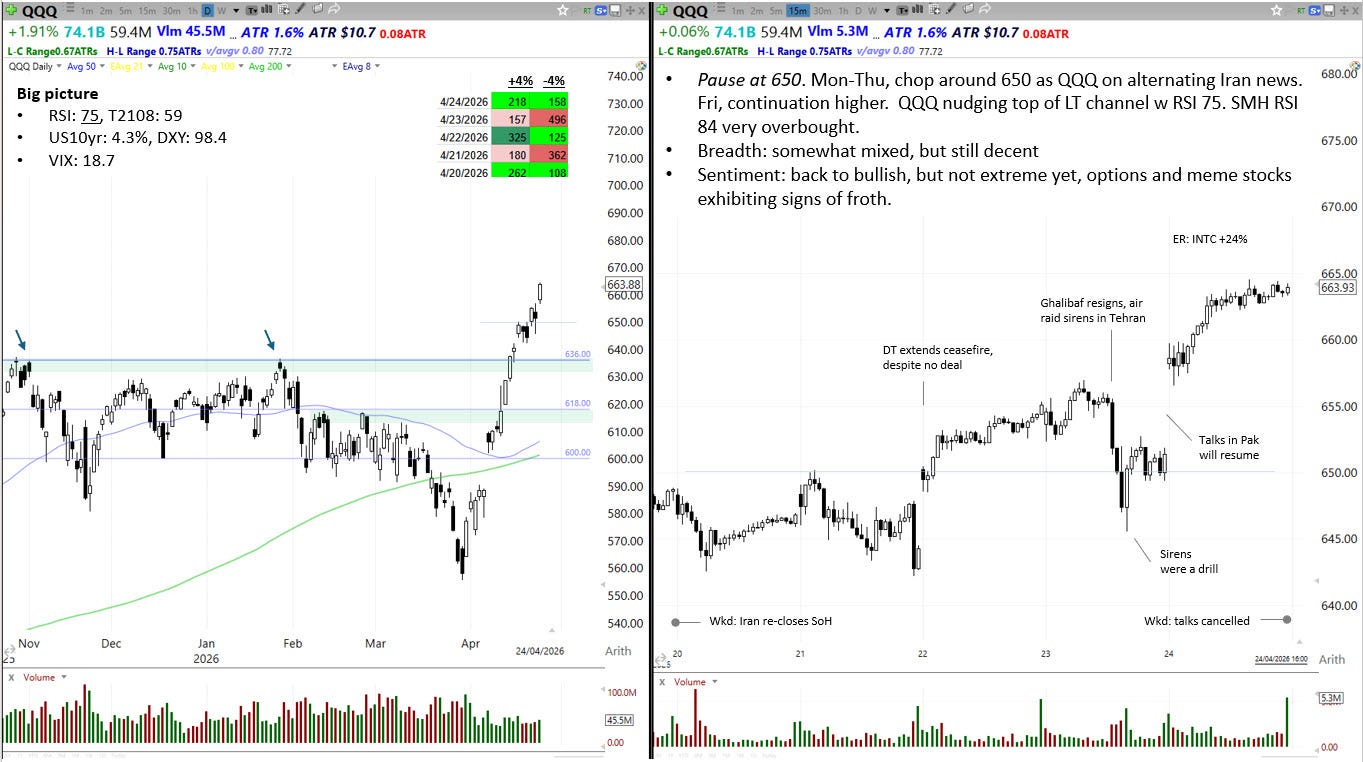
Having reached a short term overbought condition, QQQ paused around 650 from Monday to Thursday. Headlines about the conflict in Iran continue to be contradictory and confusing. On Wednesday, President Trump extended the ceasefire, claiming that the Iranian leadership has fragmented and so they need time to reorganise before a deal can be agreed. On Thursday afternoon, it was reported that air raid sirens were sounding in Tehran, raising fears that hostilities had resumed. QQQ dropped -1.5%, but then bounced an hour later when it was reported the sirens were just part of a drill. Then on Friday, it was reported US/Iran talks were going to take place over the weekend, leading to a strong close. However, over the weekend we have heard these talks were cancelled.
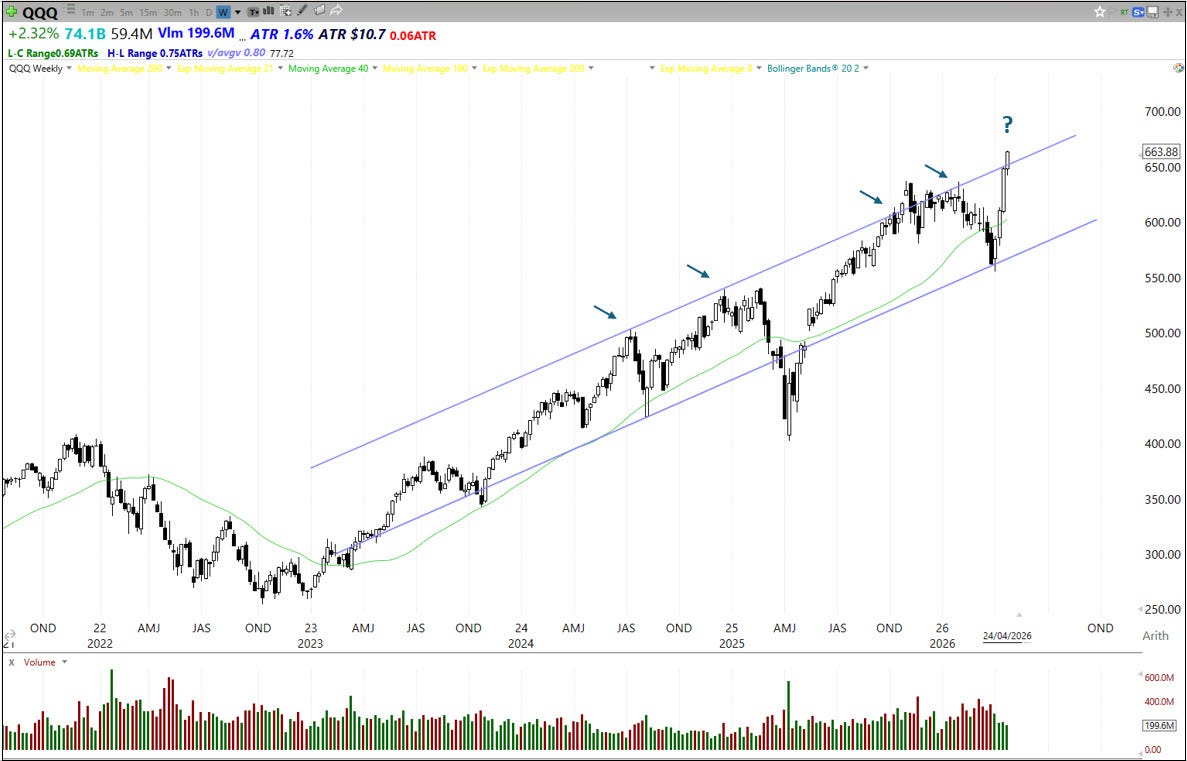
Weekend markets don’t imply a big move when futures reopen, however we should note QQQ’s daily RSI is now up to 74. It’s also nudging into the top of the long term bullish channel in play since 2022 (see chart below). Trendlines are problematically subjective because there are usually many different ways to draw them, but QQQ looks like it’s approaching resistance. Although that suggests we should expect some backing and filling, the good news is that the longer-term primary bullish trend appears to have reasserted itself.
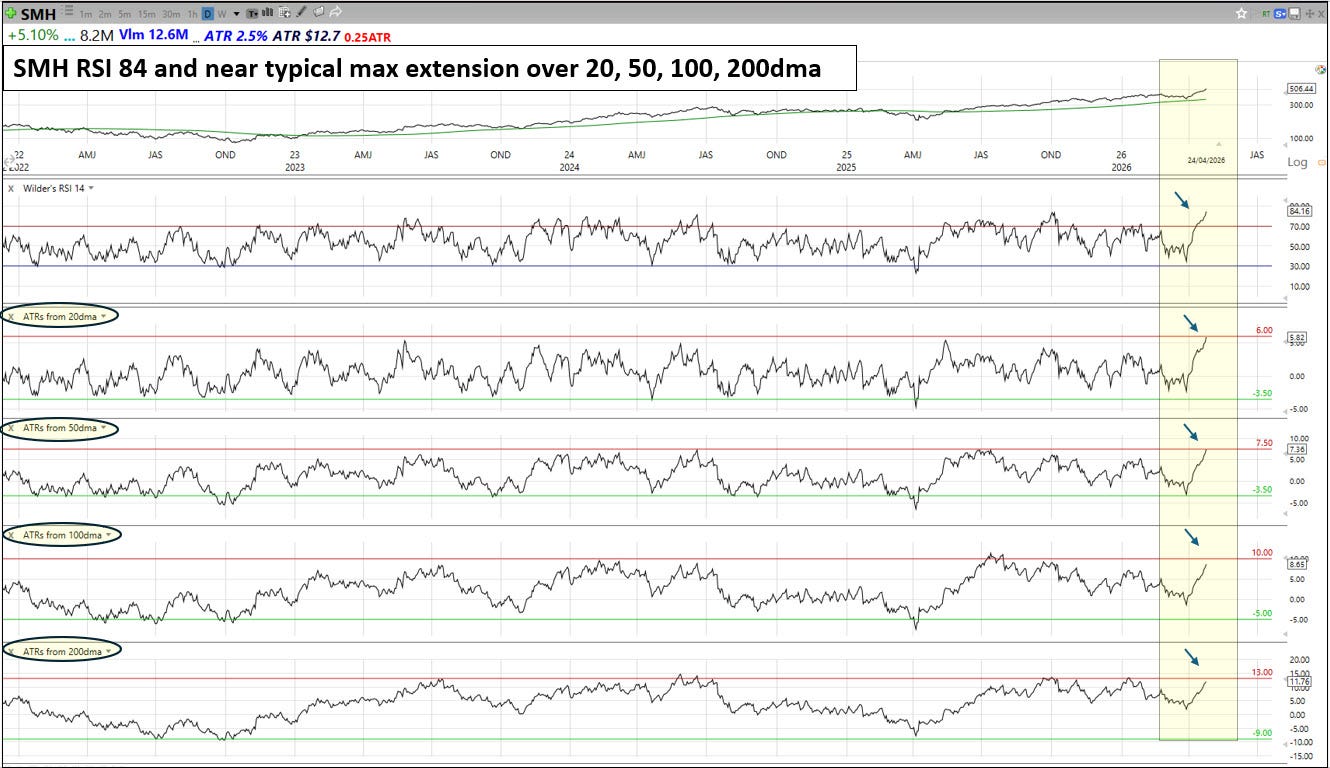
A chart that’s even more overbought is the semiconductor ETF, SMH, which is up 32% in April. Its RSI is now a very high 84, while it is extended from its moving averages (see below). Semis and semi-adjacent stocks make up 25-30% of QQQ, so this is significant.
The Fed
The big Fed event of the week was Kevin Warsh’s confirmation hearing on Tuesday. He said a couple of things that sounded pretty dovish. First, his comments about which inflation metric the Fed should use:
The measures I prefer are things that are called trimmed averages, where we take out all of the tail risks, all of the one-off items, and we ask ourselves whether the generalized change in prices is having second order effects on the economy. Again, they're not where they should be, but I think that the trend is quite favorable.
This was a dovish thing to say because trimmed averages, like the Dallas Trimmed Mean at 2.3% and the Cleveland Trimmed Mean at 2.6%, are lower than Core PCE around 3%. Moving the goalposts by changing the Fed’s preferred metric would give Warsh immediate room to cut.
Second, Warsh appeared to repeat, albeit in a slightly more roundabout manner, his assertion that AI productivity gains will be a disinflationary force that will enable the Fed to cut.
AI is quickly coming at escape velocity, it's important to revisit the Fed's models and see whether this innovation cycle could have over time improvements in the price level and make the Fed's job on inflation easier - though there's a question about what that means for employment, which is another part of the Fed's mandate.
QQQ’s run up may not only be pricing in an end to hostilities in the Middle East, it may also be pricing in a dovish Warsh pivot.
Markets & Narratives
Three narrative threads have acted as headwinds to QQQ in the first months of the year: Iran, private credit, and AI disruption. Over the last couple of weeks we’ve seen progress on all three. Fears about an enduring energy shock have been alleviated by the current, albeit fragile, ceasefire in Iran. Fears about private credit have been alleviated by the earnings reports of companies linked to the space including JPM and BX. And fears about AI disruption have eased, which can be seen in the stabilisation of IGV, and the decent bounce in stocks like MSFT and ORCL, +20% and +29% respectively. Of course any one of these stories could deteriorate again, but for now QQQ is facing much less severe headwinds than a month ago.
Breadth
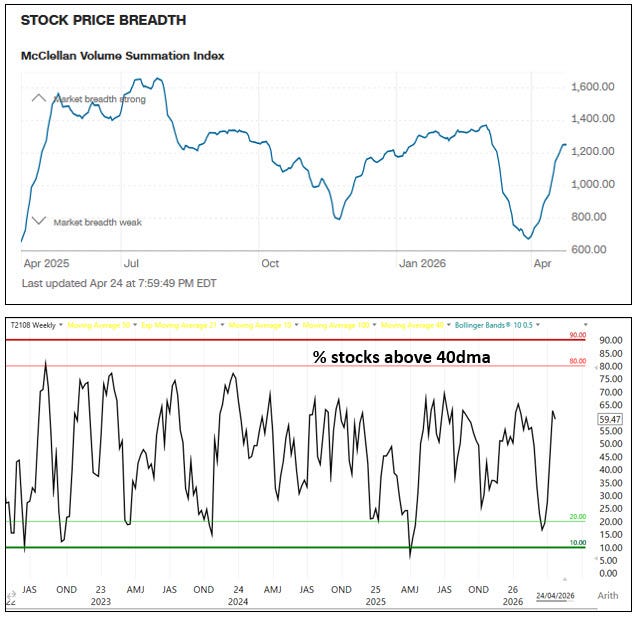
Breadth is still decent, but took a pause along with the indices this week. Both the McClellan Summation Index and % of stocks above their 40dma levelled off.
Sentiment & Positioning
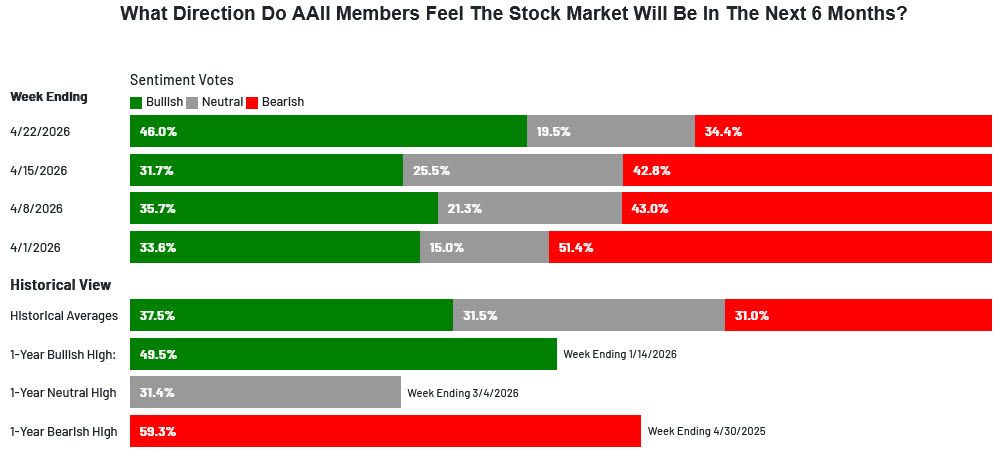
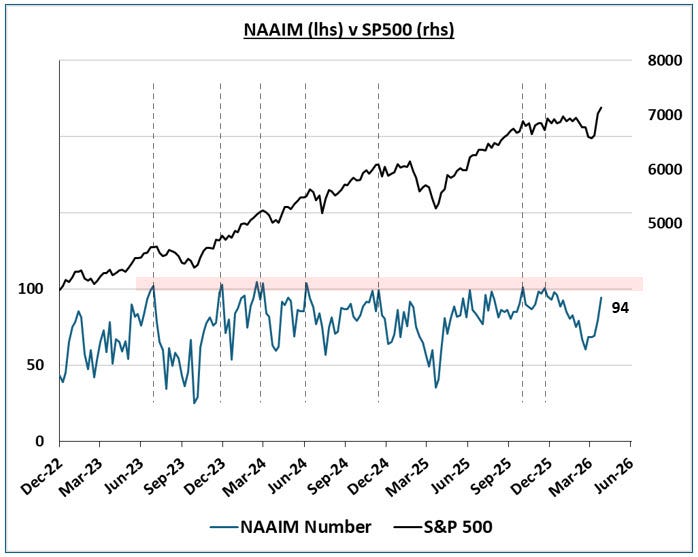
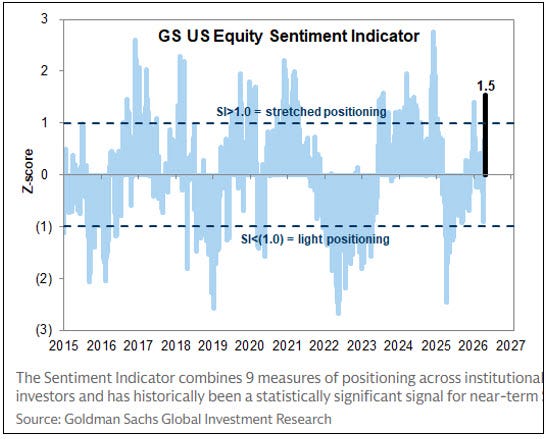
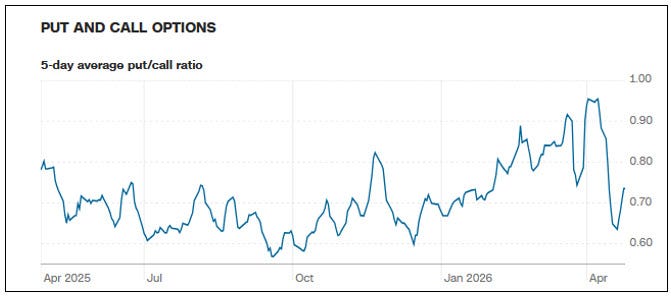
Helene Meisler’s motto is “nothing like price to change sentiment”. As stocks have recovered, the surveys show a marked jump in bullishness. However, they are not yet at an euphoric extreme, which can take a little longer to develop.
AAII shows more bulls than bears for the first time in months
The NAAIM number jumped to 94, which is a big change. It’s not far off the danger zone above 100, a reading that has preceded pullbacks and consolidations since the rally began in 2022.
The GS US Equity Sentiment Indicator also jumped higher.
As for the options market, the put call ratio 5dma has come down a lot.
Seasonality
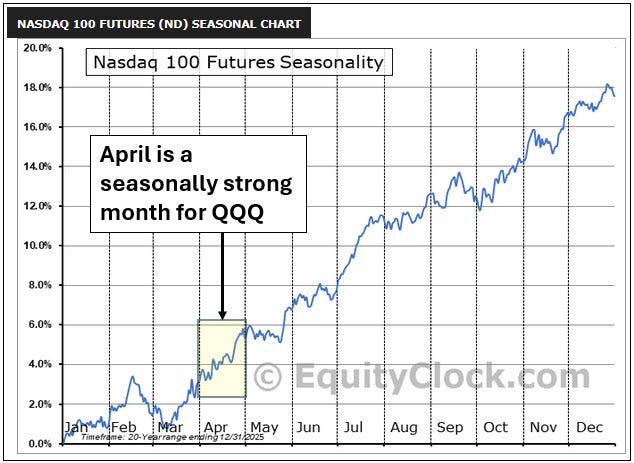
Strong seasonality in April gives way to weaker seasonality in May.
Summary
Price action: QQQ paused for four days, then pushed higher on news of US/Iran talks. QQQ is overbought with an RSI of 74 and pushing into channel resistance on the weekly chart. SMH is very overbought, with an RSI of 84. The longer-term bullish primary trend has reasserted itself.
The Fed: Fed Chair nominee, Kevin Warsh, offered views on inflation and AI at his confirmation hearing, which were dovish.
Markets & Narratives: headwinds from Iran, private credit, and AI disruption have eased.
Breadth: strong recovery levelling off.
Sentiment & Positioning: returning to bullish, but not yet euphoric.
Seasonality: April is seasonally strong for QQQ, May is weaker.
Key events next week: US/Iran headlines, Fed day (Weds), ISM-M (Fri), major earnings - MSFT, AMZN, META, GOOGL, AAPL, SNDK, STX, TER, KLAC, APH
View
Short-term: momentum strong, but price action stretched
Base case short-term continues to be for a slowing of the rip higher and a consolidation of April’s huge moves in tech and SMH - based on overbought price action, breadth levelling off, sharply rising bullishness, and less supportive seasonality as we move into May. If we get a strong pullback, 636 is obvious support, about -3.5% lower. However, momentum is strong and it’s not impossible that blow-out MAGS earnings and a peace deal could see even further extensions higher. Staying open-minded.
Long-term: cautious bullish
From a technical perspective, QQQ has done what it needed to do to reclaim its long-term primary bullish trend - it’s back inside its long-term channel and back above its moving averages. However, the fundamentals are not quite so clear cut, hence still some caution. On the one hand, the major narrative headwinds have faded, earnings season has started well, and Warsh may bring a more dovish Fed. On the other hand, the oil price shock is not over yet, and mid-term seasonality is not helpful till the back end of the year.
Challenges and risks
Iran conflict and energy shock
AI disruption
Weak mid-term seasonality
PS…
If you enjoy these posts and find them useful, please do share with colleagues, friends, or on social media - thanks!
Alex
https://www.linkedin.com/in/alex-campbell-cfa-cmt-876b331/